
Недавно я написала сообщение, где рассказывала, как вокисты на кампусах используют целую палитру стратегий, чтобы создавать у студентов впечатление, будто мир линейно движется от правых идей к левым.
Они даже не прячутся.
Вот, например, из сегодняшнего Нью-Йорк Таймс: колонка президента известного и очень престижного университета Уэслеян (строго говоря, это — liberal arts college, но в данной ситуации разница не важна; liberal arts college, грубо говоря, это — университет без аспирантуры).
В колонке этот очень публичный университетский администратор поздравляет студентов всей страны с началом учебного года.
Как мило. А пишет он следующее:
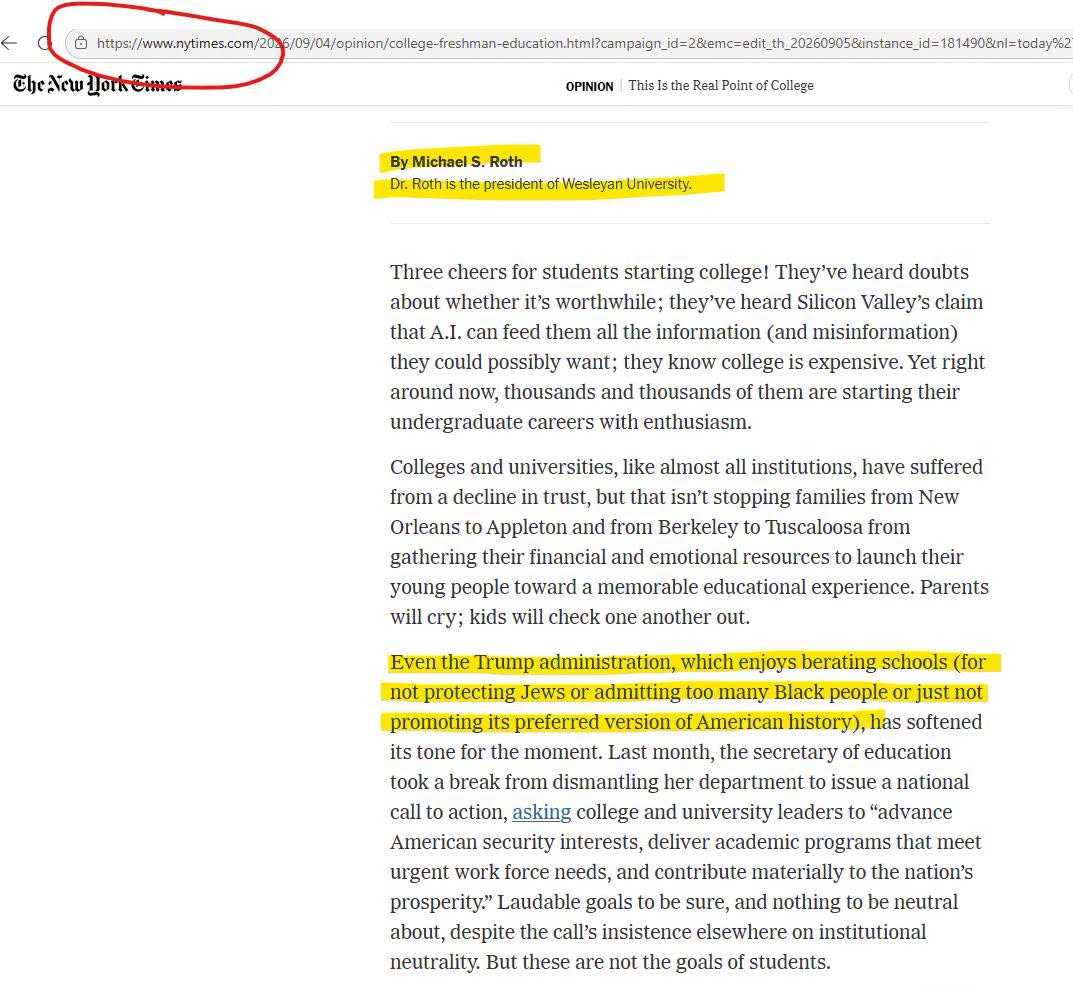
Даже администрация Трампа, которая любит критиковать университеты (за то, что те не защищают евреев, принимают слишком много чернокожих или просто не продвигают угодную ей версию американской истории), на данный момент смягчила тон.
Видите параллелизм?
Плохая администрация Трампа совершенно беспочвенно нападает на университеты.
Во-первых, какая глупость — требовать, чтобы университеты защищали евреев.
Во-вторых, какая мерзость — требовать «не принимать слишком много чернокожих». А вы думали, правительство требует прекратить дискриминацию? Ой, нет. Дискриминация — это анти-дискриминация, расизм — это анти-расизм, мы всегда воевали с Океанией.
В-третьих, отвратительное правительство требует, чтобы универы прекратили продвигать исламизм, расизм, антисемитизм и прочую левую пропаганду.
Кстати, левые политики, включая Обаму и Байдена, постоянно выдвигали требования и к университетам, и к Голливуду, и к масс медиа продвигать угодную им версию истории.
Но это не считается неправильным. Это другое!
А вот и продолжение:
В прошлом месяце министр образования, взяв перерыв от работы по демонтажу своего департамента, выступила с общенациональным призывом к действию. Она обратилась к руководителям колледжей и университетов с просьбой «отстаивать интересы национальной безопасности США, внедрять образовательные программы, отвечающие насущным потребностям рынка труда, и вносить существенный вклад в процветание страны». Цели, безусловно, похвальные и не допускающие нейтрального отношения — вопреки тому, что в других частях этого же обращения особо подчеркивается необходимость институционального нейтралитета.
Вы, наверное, пропустили половину этих шпилек. Но я вам немного подскажу, где они.
Во-первых, хаха, как смешно и глупо, что министр образования занимается демонтажом своего департамента.
Казалось бы, вот же шанс поаплодировать, во-первых, демонтажу глубинного государства и непрозрачного и неподконтрольного болота, а во-вторых, факту того, что министр образования — обожэмой! — подчиняется Президенту, а не защищает бюрократические интересы и не саботирует.
Во-вторых, хахаха, какие тупые, требуют «институционного нейтралитета», а сами не нейтральны! Лицемеры.
Это потрясающе. Министерство образования не может быть «нейтральным», ибо оно есть правительство. Его выбрали для того, чтобы оно продвигало политику, которую поддерживали избиратели. Это университеты обязаны быть нейтральными, а правительство — нет.
Особо прекрасно, что он не считает нейтральными цели «внедрять образовательные программы, отвечающие насущным потребностям рынка труда, и вносить существенный вклад в процветание страны».
Это прям вау какие спорные цели.
При этом, во времена погромов БЛМ многие университеты вполне официально сформулировали институционные цели: отказ от нейтральности, поддержку левому расизму, антсемитизму, исламизму и социализму.
Требовать от них прекратить всё это и вернуться к нейтральности — это отказ от нейтральности.
Не перепутайте.
Институционная поддержка дискриминации и требование не-дискриминации — одинаковое отсутствие нейтральности.
Если одно правительство, скажем, Байдена, преуспело в продавливании в университетах политики анти-нейтральности, то следующие правительства не имеют права требовать, чтобы университеты вернулись к нейтральности.
Ибо такое требование будет не нейтрально.
И это в открытую пишет президент престижного университета.
Представьте, как хорошо в этом университете живется студентам-евреям при президенте, который отрицает существование антисемитизма на кампусах.
Представьте себя в классе по философии, который преподает этот президент универа. Представьте, как вы отреагируете на инструкции, что критиковать демографические квоты и требования институционной нейтральности нельзя.
Это прям крик к Минюсту — скорее подавайте иск против Уэслеяна! Этот кретин вам наговорил достаточно для того, чтобы сформулировать дискриминационные мотивы.
Полный текст здесь
Opinion
Guest Essay
This Is the Real Point of College
Sept. 4, 2026
By Michael S. Roth
Dr. Roth is the president of Wesleyan University.
Three cheers for students starting college! They’ve heard doubts about whether it’s worthwhile; they’ve heard Silicon Valley’s claim that A.I. can feed them all the information (and misinformation) they could possibly want; they know college is expensive. Yet right around now, thousands and thousands of them are starting their undergraduate careers with enthusiasm.
Colleges and universities, like almost all institutions, have suffered from a decline in trust, but that isn’t stopping families from New Orleans to Appleton and from Berkeley to Tuscaloosa from gathering their financial and emotional resources to launch their young people toward a memorable educational experience. Parents will cry; kids will check one another out.
Even the Trump administration, which enjoys berating schools (for not protecting Jews or admitting too many Black people or just not promoting its preferred version of American history), has softened its tone for the moment. Last month, the secretary of education took a break from dismantling her department to issue a national call to action, asking college and university leaders to “advance American security interests, deliver academic programs that meet urgent work force needs, and contribute materially to the nation’s prosperity.” Laudable goals to be sure, and nothing to be neutral about, despite the call’s insistence elsewhere on institutional neutrality. But these are not the goals of students.
A significant percentage of first-year students are entering community college, and many of them will be looking for classes that prepare them for jobs in the near term. Nursing, information technology, the electrical trades and education will appeal to many, but the most popular areas of study are in the liberal arts. That’s no surprise because the liberal arts prepares students to pivot in many directions given shifting labor force needs.
And those shifts will be significant. Artificial intelligence is reshaping how tasks are completed almost everywhere. That’s why students at community colleges, like their counterparts at four-year schools, hope to learn to use large language model tools and develop the human capacities for discernment, for making sense of when and how to use the powerful research and analytic powers of A.I. The students are learning specific skills, to be sure, but they are also learning how to add human value to work in a marketplace infatuated with the wonders of automation.
Despite the pressures of a perilous job market, students often use the first semester for exploration. Course catalogs will include titles that baffle recent high school graduates and lead to head-scratching moments for parents and pundits. But this is nothing new. Some schools provide a core curriculum, and despite oft-repeated stories of far-left professors pouring woke doctrine down the throats of naïve youngsters, the writings of Plato, Machiavelli and Mary Shelley remain among the most assigned college readings in America.
Students in my humanities course this fall will begin with Confucius, Aristotle and Aquinas. Very few of my undergrads will major in philosophy, but almost all, I expect, will approach the material with energetic curiosity. They always do. Why? Because they are taking the opportunity to discover who they are as readers, as conversation partners, as people. They are figuring out what kind of work they find fulfilling, what they love to do.
That said, it is essential that students also learn how to get better at the work they’ve signed up for. Discovering one’s passion is not enough. Through vigorous practice, students should learn to work harder and better, so they can go further than they’d thought possible. If they use A.I. to avoid having to work hard, they’ll learn little.
Grade inflation, too, is pernicious, because it signals to young people that they’ve already mastered a task when they’ve really just begun to get the hang of it. Teachers must get over their fear of alienating students by setting high standards, and undergraduates must come to understand that they can do much better than they’ve already done. And they need to learn without undue dependence on technology.
Editors’ Picks
Every Family Has Its Own Private Language. What Does That Tell Us About Ourselves?
My Teenage Daughter’s Friend Has a Drinking Problem. Should I Tell Her Parents?
Where To Find Fast-Disappearing Prune Danishes and More Reader Questions
I’ve been teaching college students for over 40 years, and one of the great pleasures for me at the beginning of the school year is seeing students develop friendships in their new surroundings. It may happen in a science lab or on a sports team, or through a discussion begun in class and carried over into the dining hall or the dorm. Every year I meet alumni in ripe old age who are still buddies with (or even married to) people they got to know in the first weeks of school. I’m convinced that there is something about young folks opening themselves to new possibilities in college that sets a durable foundation for long-lasting relationships.
Yes, college is less affordable than it should be; yes, there’s still a long way to go in improving intellectual diversity and pluralism on campus. Yes, it’s all too easy to mock the bombast or simple riotousness of the young. From Thomas Jefferson to Richard Nixon to Donald Trump, people have raised complaints about college students. After all, these students are learning how to practice freedom — the opposite of trying to figure out just how to fit into the world that is being left them.
Today’s students are trying to work out what it means to be decent humans in a world growing more heated, hostile and, sometimes, heartless. We should cheer them on, for their sake and ours.