Г-споди, какое дно.
Несколько лет назад Кембриджский университет принял на профессорскую должность Джейсона Ардея — человека, чьи академические заслуги были близки к нулю, патологического лжеца и плагиатора.
После его смерти университет пообещал расследовать — как они могли назначить профессором человека со столь очевидно отсутствующей квалификацией?
Если вы хоть что-то понимаете в общественных науках, вам хватит 5 минут чтения его опусов, чтобы понять, что это за птица. Тут можно даже не расследовать плагиаторство. Его «научные работы» — уровня курсовой слабого студента бакалавриата из слабого университета.
Но уже проехали.
Вместо этого будут расследовать, достаточно ли Кембридж поддерживал Ардея, когда всплыло, что тот сплагиатил свою диссертацию.
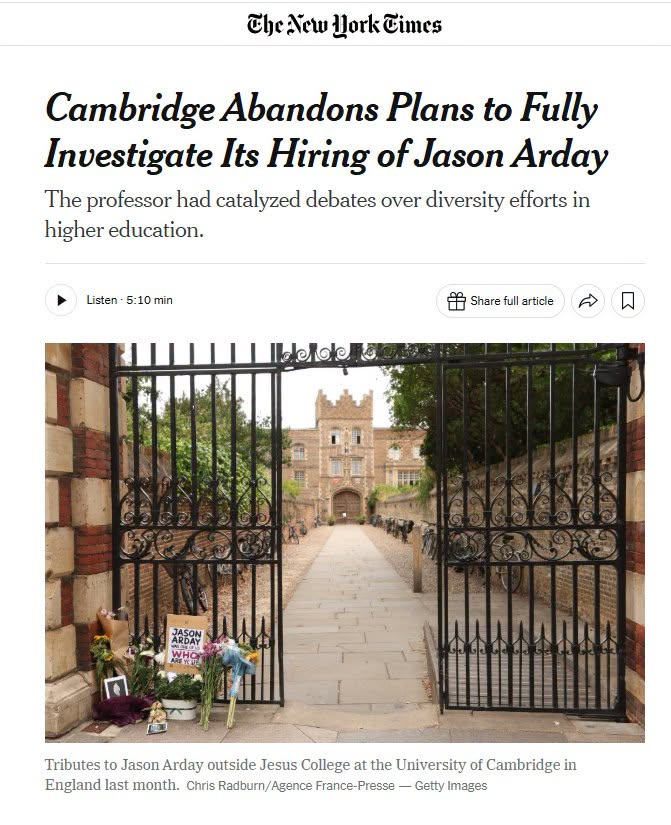
[Кембриджский университет] отказался от планов провести всестороннее расследование обстоятельств найма Джейсона Ардея...
Вместо этого, как заявили в университете, в ходе проверки будет выясняться, получал ли ученый достаточную поддержку на фоне обвинений в том, что он допустил плагиат в своей докторской диссертации и приукрасил факты собственной биографии.
Имя доктора Ардея может упоминаться в рамках более широкого анализа практики найма персонала в университете, однако он не будет центральной фигурой расследования.
Это решение знаменует собой резкий отход от планов, озвученных летом: тогда проректор университета Дебора Прентис обещала провести «тщательное и прозрачное» расследование обстоятельств назначения... Ардея.
Смена фокуса расследования означает, что Кембридж, возможно, так и не даст публичных ответов на вопросы о том, как проводилась проверка кандидатуры доктора Ардея при приеме на высокую преподавательскую должность и почему руководство неоднократно игнорировало опасения по поводу его профессиональной деятельности и биографии.
Это вызвало недовольство части преподавательского состава: как следует из черновика письма, с которым ознакомилась газета The New York Times, они требуют от университета полной ответственности и проверки того, как именно продвигалось личное дело доктора Ардея.
Полный текст статьи НЙТ
The University of Cambridge has abandoned plans to fully investigate its hiring of Jason Arday, the professor who became a lightning rod in the debate over diversity-and-inclusion efforts in higher education, following his abrupt death last month. Instead, the university said, the inquiry will examine whether the school offered him sufficient support amid accusations that he plagiarized portions of his doctoral thesis and embellished his personal narrative. Dr. Arday may come up as part of a broader look at university hiring practices, but he will not be a focus. That marks an abrupt shift from the plan announced this summer, when the school’s vice chancellor, Deborah Prentice, promised a “thorough and transparent” investigation into Dr. Arday’s appointment. Dr. Arday died last month amid intense scrutiny of his biography and a deluge of personal, sometimes racist, taunts online. No official cause of death has been released, but his family said that the “campaign of misinformation was too much for Jason.” The change in investigative focus means that Cambridge may never publicly address questions about how it vetted Dr. Arday for a senior teaching job and why it repeatedly downplayed concerns about his work and biography. That has upset some professors, who are circulating a letter demanding full institutional accountability and an examination of how the university promoted Dr. Arday’s personal story, according to a draft seen by The New York Times. Cambridge touted Dr. Arday as its youngest Black professor ever after he was hired at age 37 in 2022. He had claimed he could not speak until age 11 or read until age 18, a trajectory with no precedent in clinical literature. Some faculty members said that by pushing him into the spotlight, the university distracted from its diversity record. Of the 584 full professors at Cambridge who reported their race the year that Dr. Arday was hired, three were Black. A faculty letter this summer, before Dr. Arday’s death, criticized administrators for “crafting a media narrative focusing on his youth, his race, and his transformative potential.” Editors’ Picks Love Agatha Christie? Read These Books Next. This Zoo Helps Protect Baby Turtles, Then Sends Them on Their Way Would You Bring Iced Coffee to a Job Interview? The Internet is Divided. Image A large crowd gathers in front of a classical building. A vigil in August to remember Mr. Arday in London.Credit...Carlos Jasso/Agence France-Presse — Getty Images That narrative, which led to a high-profile memoir published by Simon & Schuster, is now outside the scope of the investigation. For the most part, so are questions surrounding the hiring of Dr. Arday, an early-career scholar with a modest publication record, for a prestigious professorship in education. Cambridge has appointed a respected former prosecutor to lead the review but has narrowed the scope. The investigation is “not about the allegations made against Professor Arday or about his academic record,” the former prosecutor, Nazir Afzal, said recently. “It’s about his welfare, his care, his well-being.” It will go “deep on a narrow question rather than broad on all of them,” Mr. Afzal, who is also chancellor of the University of Manchester, noted in a post. A second, broader inquiry by an expert panel may touch on Dr. Arday’s years at Cambridge but will not focus on him. The second review “will consider the wider context of Professor Arday’s time at the University of Cambridge” by examining policies on hiring and academic misconduct, along with “the support available to academics who are subject to extraordinary public and media scrutiny,” a university description of the inquiry reads. A university spokesperson declined to explain the change or answer questions about it. The faculty is divided in the wake of Dr. Arday’s death. While some criticize the narrowed scope of the investigation, others take issue with Cambridge’s reproval of the professor in the days before his death, pointing to the vice chancellor’s description of his case, in a letter to staff, as an “aberration.” The episode is adding to controversy around the elite institution, which starts its fall term next week. A finance scandal in Britain’s right-wing Reform U.K. party has put scrutiny on the Cambridge theologian James Orr, a former adviser to the party who has been the subject of student complaints, according to The Financial Times. Cambridge has also lost a case brought by a professor who said he was targeted for being a whistle-blower, in a ruling that singled out Dr. Prentice and human resources staff members for criticism. The university spokesperson said Cambridge was “looking into” the allegations against Dr. Orr and “looking hard at the judgment” and facts in the whistle-blower case.